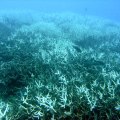
In the Florida Keys, the U.S. Virgin Islands and Maui, coral reef degradation has caused sea floor depths to increase as sand and other sea floor materials have eroded over the past few decades, the USGS study found. In the waters around Maui, the sea floor losses amounted to 81 million cubic meters of sand, rock and other material – about what it would take to fill up the Empire State Building 81 times, the researchers calculated.
Climate Change
Researchers Explains Coral Reef Bleaching
We now have a 2017 event, which is not quite as bad as 2016, but certainly worse than the first two events that we studied [in 1998 and 2002]. That is significant because it postpones any hope of recovery. The current bleaching occupies a different geographical footprint from last year, which is bad news because it means between last year and this year a much greater extent of the Great Barrier Reef has now been damaged. In 2017, the hot water was in the middle of the Great Barrier Reef, the central section; last year it was in the north.
New Study On Arctic Ice Melt
Arctic sea ice has been rapidly declining since satellites first started tracking it in 1979, and according to NASA, roughly 13.3 percent of the ice disappears every decade. Models have projected that manmade global warming would heat the Arctic faster than it would heat more temperate regions, and observation has borne that out. The Arctic is warming at least twice as fast as the rest of the globe, and the first two months of this year both had the lowest levels of sea ice on historical record.
Coral Reefs Face Extinction
“To lose coral reefs is to fundamentally undermine the health of a very large proportion of the human race,” said Ruth Gates, director of the Hawaii Institute of Marine Biology
‘Decline in dissolved oxygen in oceans around the world
A large research synthesis, published in one of the world’s most influential scientific journals, has detected a decline in the amount of dissolved oxygen in oceans around the world — a long-predicted result of climate change that could have severe consequences… Read More ›
Warming Seas Impact Alaskan Marine Ecosystem
Farther south, the Bering Sea has emerged as a hot spot for warming-water studies — almost literally. Sea-surface temperatures in the Bering reached 14 degrees Celsius last summer (57 degrees Fahrenheit) and were generally 3 degrees Celsius (5 degrees Fahrenheit) warmer than normal, scientists reported.
Arctic Ocean “Menu is Changing”
The Arctic Ocean may seem remote and forbidding, but to birds, whales and other animals, it’s a top-notch dining destination. “It’s a great place to get food in the summertime, so animals are flying or swimming thousands of miles to… Read More ›
Ocean Circulation & Climate Change
A huge amount of heat is moved around our planet by a single ocean current system — the Atlantic Meridional Overturning Circulation (AMOC) — which accounts for up to a quarter of the planet’s heat flux. The system is driven… Read More ›
Science Continues Melting Sea Ice Studies
In the vast and chaotic climate systems that govern our atmosphere and oceans, making sense of how one change — diminished sea ice — affects places or people thousands of miles away is a task of such extraordinary complexity that it strains even the most sophisticated supercomputers.
Understanding Ocean Acidification
“Oregon is ground zero for ocean acidification impacts–the water chemistry off our coast is already changing and has changed dramatically. For a glimpse into the science, the impacts and the information gaps behind ocean acidification in Oregon, check out the… Read More ›