By David Helvarg Fifteen years ago I was in Fiji on assignment for the book Feeling the Heat, a collection of dispatches from 10 journalists who traveled the world to report on the already visible effects of climate change. In… Read More ›
By David Helvarg Fifteen years ago I was in Fiji on assignment for the book Feeling the Heat, a collection of dispatches from 10 journalists who traveled the world to report on the already visible effects of climate change. In… Read More ›
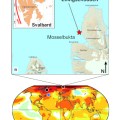
Although Arctic-wide warming during the 20th century is well documented, little is known about the response of sea-ice to abrupt warming and it is unclear when the sea-ice decline started. Data coverage in this region is highly restricted, with observation-based satellite data only available since the 1970s, too short to accurately calibrate climate models.

“We were alarmed to find that diatoms were so negatively affected, with some species likely to have diminished silica production before the end of this century,” says Dr Petrou.
…marine animals like fish, crabs and lobster are already more likely to be living near the threshold of life-threatening temperatures, and because in the ocean, there are fewer places to hide from extreme heat, said Malin Pinsky, lead author of a new study published Wednesday in the journal Nature.
“These results are stunning, in part because the impacts of climate change on ocean life were virtually ignored just a decade ago,” said Pinsky, an ocean researcher at Rutgers University. The study took a close look at cold-blooded marine species whose body temperatures are dependent on their surroundings.

Editor’s note: The consistently disturbing news of marine mammals dying off or stranding in mass appears to be a global event. Gray whales are an iconic species that have survived throughout the centuries, including the great whale hunts of the… Read More ›

n February, southwest winds brought warm air and turned thin sea ice into “snow cone ice” that melted or blew off. When a storm pounded Norton Sound, water on Feb. 12 surged up the Yukon River and into Kotlik, flooding low-lying homes. Lifelong resident Philomena Keyes, 37, awoke to knee-deep water outside her house.
“This is the first I experienced in my life, a flood that happened in the winter, in February,” Keyes said in a phone interview.

Editor’s Note: A recent NY Times report is headlined, “The Great Barrier Reef was Seen as ‘Too Big to Fail.’ A Study Suggests It Isn’t.” The following is an abstract, “Global warming impairs stock–recruitment dynamics of corals” released Wednesday in… Read More ›

The study, published Monday in the journal Nature Climate Change, looked at the impact of marine heat waves on the diversity of life in the ocean. From coral reefs to kelp forests to sea grass beds, researchers found that these heat waves were destroying the framework of many ocean ecosystems.

As the oceans continue to heat up, those effects will become more catastrophic, scientists say. Rainier, more powerful storms like Hurricane Harvey in 2017 and Hurricane Florence in 2018 will become more common, and coastlines around the world will flood more frequently. Coral reefs, whose fish populations are sources of food for hundreds of millions of people, will come under increasing stress; a fifth of all corals have already died in the past three years.
Scientists say West Coast waters now have a hypoxia season, or dead-zone season, just like the wildfire season. Hypoxia is a condition in which the ocean water close to the seafloor has such low levels of dissolved oxygen that the… Read More ›
 Neptune 911!